
How to Prioritise Like a Pro: A Fun Guide to the RICE Method in Product Management
Hey there! If you’re in the thick of product management, you know that juggling feature requests can sometimes feel like being a circus performer with too many balls in the air. But don’t worry; we’ve got a nifty trick up our sleeves to keep you steady – the RICE method. The acronym RICE stands for Reach, Impact, Confidence, and Effort. It sounds like a bowl of wholesome goodness to fuel your product decisions, right? Let’s dive in and see how it can help clear the air.
Meet the RICE Method
Imagine RICE as a handy map to guide you in prioritising product features. Each letter stands for a helpful signpost:
- Reach: This is your audience size for a feature in a specific timeframe. Think of it as your crowd of spectators.
- Impact: How much of a bang will your feature create in your user’s world? This measures the oomph factor.
- Confidence: How certain are you about your reach, impact, and effort estimates? Do you believe in your crystal ball?
- Effort: This is the sweat and toil your team needs to bring the feature to life.
You give each feature a RICE score based on these four signposts, and voila! Decision-making becomes a breezy walk in the park.
Getting to grips with the RICE Method
Count your audience – Determine Your Reach
First, determine how many people each feature will benefit in a given time frame. Like, if you’re rolling out a new search function that 10,000 users will find helpful in a month, that’s your reach.
Measure the bang – Evaluate Your Impact
Next, consider how much the feature will affect the user. How much more awesome will it make their experience? We usually measure this on a scale from 0.25 (just a slight improvement) to 3 (mind-blowing change!).
Trust in your crystal ball – Assess Your Confidence
Confidence means how certain you are about your estimates for reach and impact. Are you just wildly guessing, or are you confident in your numbers? Use a percentage from 50% (a total shot in the dark) to 100% (rock-solid certainty).
Sweat it out – Calculate Your Effort
Think about how much work it’ll take for your team to roll out the feature. It’s usually measured in “person-months”, which is how much one person can achieve in a month.
Bring it all together – Calculate the RICE Score
Once you’ve got your reach, impact, confidence, and effort estimates, you can calculate the RICE score using this formula:
RICE Score = (Reach * Impact * Confidence) / Effort
The RICE Effect: Straightforward Prioritisation and Decision-making
Here’s where the magic happens. The RICE method gives you a clear, easy-to-understand way to rank features. It’s like having a blueprint for decision-making, showing why some features should be tackled before others.
Better yet, it helps your team all get on the same page. By cutting through the fog of bias and subjectivity, RICE ensures everyone understands and agrees with the roadmap.

An Example
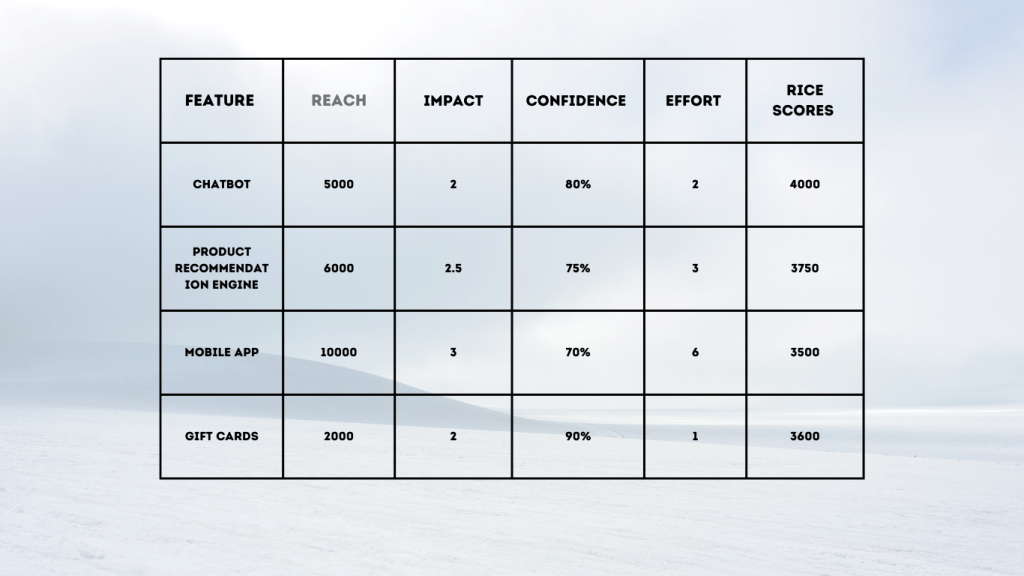
Let’s take an example of an e-commerce website that is considering four new features to implement:
- Chatbot: A chatbot to answer customer queries
- Product Recommendation Engine: A system to recommend products based on the user’s browsing history and purchase behaviour.
- Mobile App: Launch a mobile app version of the website.
- Gift Cards: Enable customers to purchase and send gift cards.
Here’s how they might use the RICE method to prioritise these features:
Chatbot
- Reach: Let’s assume we have about 5000 customers who have queries every month, so the reach is 5000.
- Impact: This feature can significantly improve customer experience by providing immediate responses, so the impact is 2.
- Confidence: The team is quite confident about their estimates, so the confidence is 80%.
- Effort: The estimated effort required to implement this feature is 2 person-months.
RICE Score = (Reach * Impact * Confidence) / Effort = (5000 * 2 * 0.8) / 2 = 4000
Product Recommendation Engine
- Reach: Assume the recommendation engine will impact 6000 users monthly, so the reach is 6000.
- Impact: Personalised recommendations can drive more sales, so the impact might be 2.5.
- Confidence: The team is relatively sure about the estimates, so confidence is 75%.
- Effort: Building a recommendation engine is complex and might require 3 person months of effort.
RICE Score = (Reach * Impact * Confidence) / Effort = (6000 * 2.5 * 0.75) / 3 = 3750
Mobile App
- Reach: The app can reach all the customers, say 10000 users in a month, so the reach is 10000.
- Impact: The mobile app can significantly boost the user experience and increase sales, so the impact is 3.
- Confidence: The team is less confident about their estimates, given the scale of the project, so confidence is 70%.
- Effort: Building a mobile app requires significant time and resources, so it might take 6 person-months.
RICE Score = (Reach * Impact * Confidence) / Effort = (10000 * 3 * 0.7) / 6 = 3500
Gift Cards
- Reach: Assume gift cards would be used by 2000 customers per month, so the reach is 2000.
- Impact: Gift cards can increase sales and attract new customers, so the impact might be 2.
- Confidence: The team is highly confident about the estimates, so confidence is 90%.
- Effort: The effort required to implement this feature is relatively low, say 1 person-month.
RICE Score = (Reach * Impact * Confidence) / Effort = (2000 * 2 * 0.9) / 1 = 3600
Based on the RICE scores, they should prioritise as follows: Chatbot (4000), Product Recommendation Engine (3750), Gift Cards (3600), and Mobile App (3500).
This simplified example shows how the RICE method helps make an objective decision about feature prioritisation based on quantifiable metrics. Please note that the numbers used in this example are fictional and meant for illustrative purposes only. Real-world decisions should be based on accurate data.
In Conclusion: Become a Prioritisation Pro with the RICE Method
Being successful in product management calls for solid decision-making skills, and RICE is your ticket to objective, data-driven decisions. By mastering this method, you can effectively prioritise features, ensuring that your product continues to make waves.
Remember, every product is unique, and there’s no one-size-fits-all solution. The RICE method is powerful, but it’s only one of many in your product management toolbox. So keep tailoring your approach, learning, and adapting to the fun and exciting world of product management.
Thanks for joining us on this journey into the RICE method! We hope you found it useful. For more gems on product management, stick around and check out our other blog posts. Stay tuned for more, and keep rocking the product world!


You May Also Like

Mastering Agile Project Management with Scrum: A Comprehensive Guide

What Is Gherkin Style? A Simple Guide for Product Owners and Agile Teams