
What Is Gherkin Style? A Simple Guide for Product Owners and Agile Teams
If you work with Agile teams, you’ve probably seen acceptance criteria written in a structured format using the words Given, When, and Then.
That format is called Gherkin — and it’s one of the most useful tools for creating clear, testable user stories.
What Is Gherkin?
Gherkin is a plain-language format used to describe how a feature should behave.
It’s widely used in Behaviour-Driven Development (BDD) and supported by tools like Cucumber.
The goal of Gherkin is simple:
✔ Remove ambiguity
✔ Create shared understanding
✔ Turn acceptance criteria into something testable
✔ Make QA, developers, designers, and POs speak the same language
Why Teams Use Gherkin
Many acceptance criteria are written vaguely, leading to misunderstandings during development.
Gherkin solves this by breaking behaviour into three parts:
Gherkin solves this by breaking behaviour into three parts:
- Given – the starting point
- When – the action
- Then – the expected outcome
This mirrors how users interact with features and how testers validate them.
Example:
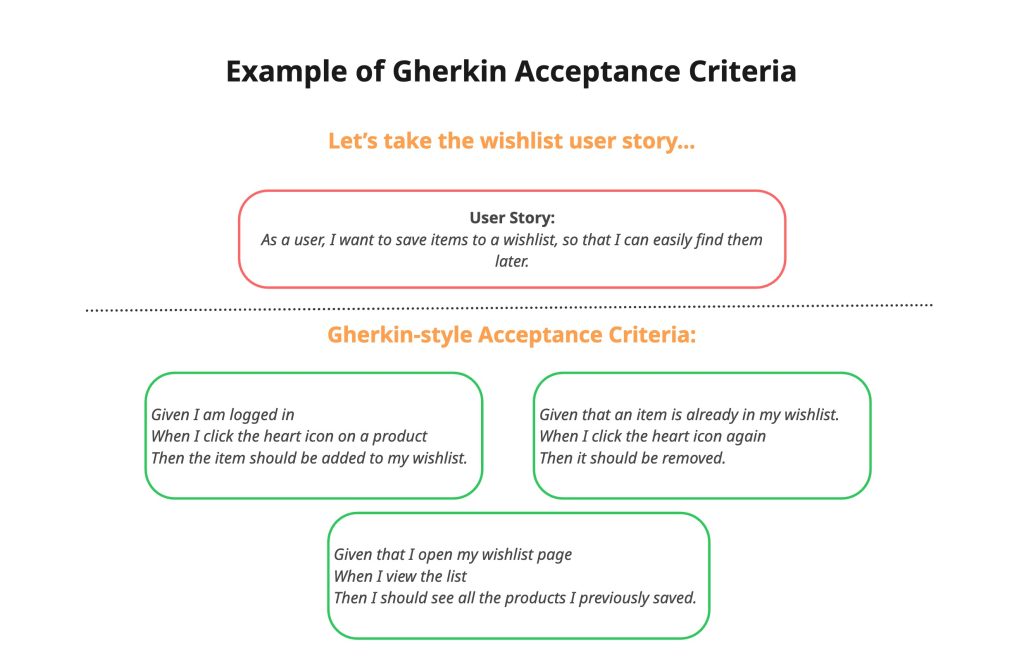
Clear. Testable. No grey areas.
When Should You Use Gherkin?
Use it when:
- Behaviour matters
- Logic changes by context
- The team needs precision
- QA needs to automate tests.
- Stories involve multiple paths or conditions.
You don’t need Gherkin for every small story — but for anything user-interactive or logic-heavy, it’s a lifesaver.

Final Thoughts
Gherkin eliminates the guesswork from user stories.
By providing structure to acceptance criteria, teams can build the right thing the first time, thereby reducing rework, confusion, and misaligned expectations.
By providing structure to acceptance criteria, teams can build the right thing the first time, thereby reducing rework, confusion, and misaligned expectations.


You May Also Like

Your Ultimate Guide to a Successful Product Launch: Step-by-Step with Real-World Example

Understanding Product Risk Taxonomy: Why It Matters and How to Manage It